
Twin Falls County Court Records After a Jail Arrest
After an arrest in Twin Falls County, the person may be booked into the Twin Falls County Adult Detention Facility at 504 Gooding Street N. The Sheriff's Office public custody source located for this project is a daily headcount PDF from the sheriff homepage, not a full interactive court or booking database. That headcount can help confirm current custody, but it does not prove the exact criminal counts that Prosecuting Attorney Grant Loebs ultimately files in court.
The court record begins with the prosecutor's filing, court clerk processing, or citation/case entry in Idaho's judicial system. For jail custody and booking-side details, use the county jail inmate records page. For booking-photo limits and the absence of confirmed public mugshots in the inspected headcount, use the jail roster mugshots page. Court records after a jail arrest are different: they track complaints, informations, indictments, hearings, warrants, bond orders, dismissals, pleas, convictions, and sentencing.
How to Find Twin Falls County Court Records After an Arrest
The primary court-search channel is Idaho's iCourt/Odyssey public portal. Search there by party name, case number, or citation-style information when available. Because name matches can be similar, compare the county, case type, date, and identifying details before treating a result as the same person who appeared on the jail headcount. The Twin Falls County daily headcount is posted from the Twin Falls County Sheriff's Office side of the process; iCourt is where the formal charge list and case activity belong.
The Idaho Odyssey Portal is the statewide court-search interface used for Twin Falls County criminal case lookup.
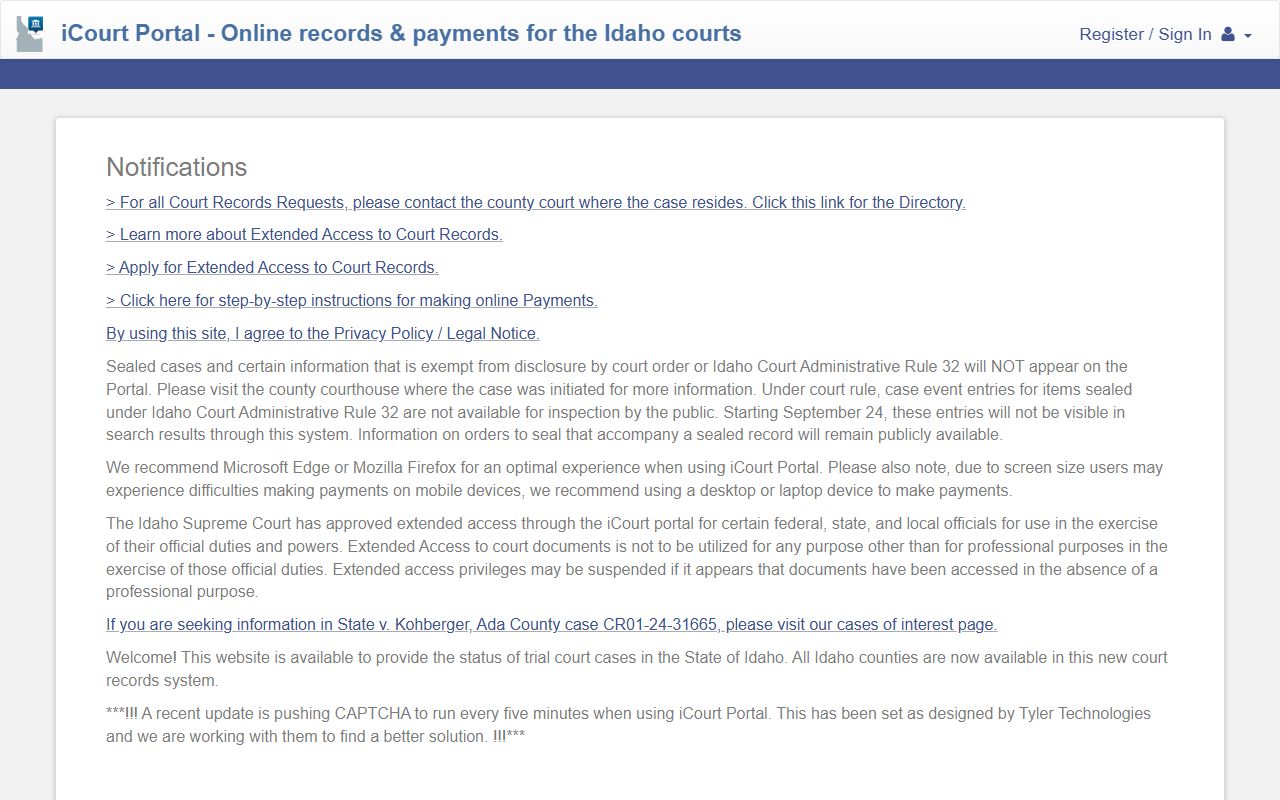
Use the portal result as a court index, then confirm restricted, older, or unclear records through the Twin Falls County Clerk or the court handling the case.
- Start with the Sheriff's Office daily headcount PDF if the question is whether the person is currently in Twin Falls County jail custody.
- Open Idaho iCourt/Odyssey and search by the exact name from the headcount, paperwork, citation, or notice.
- Narrow by Twin Falls County, criminal or traffic case type, case date, or case number if the portal exposes those filters.
- Open the matching case and review the complaint, charge list, hearing entries, warrant events, bond orders, disposition, and sentence fields that are public.
- Contact the Twin Falls County Clerk or court channel for older files, sealed matters, or records that are not available online under Idaho Court Administrative Rule 32.
Do not treat iCourt as a complete criminal-history background check. Idaho criminal-history dissemination is a separate process under Idaho law and Idaho State Police procedures. Idaho Code 19-4701 defines criminal-history-record terms for that context, while the court portal is a case-record search system.
How Charges Get Filed After an Arrest: Complaint, Information, and Indictment
A Twin Falls County jail arrest may begin with law-enforcement allegations, a warrant, or an incident report. The filed court case begins when a charging document is entered. Idaho counties use prosecuting attorneys rather than a "district attorney" title, and the Twin Falls County Prosecuting Attorney is the office that reviews referrals and determines whether to file, amend, reduce, or dismiss criminal counts. The court records after an arrest should therefore be read as prosecutor and court records, not simply as the jail's booking language.
| Document | Filed By | Common Use | What to Check |
|---|---|---|---|
| Complaint | Prosecutor or authorized charging authority | Often starts a criminal case after arrest or citation | Count text, statute section, offense level, and first appearance activity |
| Information | Prosecutor | Common in felony proceedings after preliminary steps | Whether charges were bound over, changed, or narrowed |
| Indictment | Grand jury | Less routine locally, but important for serious or grand-jury cases | Filed counts, case restrictions, and later amendments |
Charge Status in Court Records After a Twin Falls County Arrest
Charge status can change quickly after a jail arrest. A jail row may use the arresting agency's initial language, while the court case may later show a different statute, a reduced count, an amended information, or a dismissal. That is why formal court records after a jail arrest should be checked before describing a person's legal status.
| Status | What It Means | Why It Matters |
|---|---|---|
| Pending | The charge remains open and unresolved. | There has not yet been a final plea, verdict, dismissal, or sentencing entry. |
| Amended | The filed charge changed after the original entry. | The first jail or complaint wording may no longer match the active court count. |
| Reduced | The count was lowered to a less serious charge or offense level. | The conviction risk and sentencing range may differ from the arrest allegation. |
| Dismissed | The charge ended without a conviction on that count. | A dismissal is not the same as erasing every public record of the arrest or case. |
| Convicted | A plea, verdict, or finding resulted in judgment on the charge. | The record has moved beyond accusation into a court disposition. |
Bond and Release After an Arrest
Bond in Twin Falls County is a jail-and-court question. The safe workflow is to confirm custody through the sheriff's daily headcount and call the jail at 208-734-9090 for current custody and release information. Then check iCourt for case numbers, court dates, bond orders, and warrant activity. No current official Twin Falls jail payment-method table, online bond-payment vendor, local fee schedule, or bond-posting hours were located in the reviewed official pages, so those details should be confirmed before anyone travels or pays money.
| Bond Type | How It Works | Practical Twin Falls County Check |
|---|---|---|
| Cash Bond | The full amount is paid as directed by the court or jail authority. | Ask whether payment is accepted at the jail, court, or another official location. |
| Surety Bond | A licensed bail agent posts a bond for the defendant. | Confirm that a surety bond is permitted and that no hold blocks release. |
| Personal Recognizance | Release is based on a promise to appear and comply with court conditions. | Check the court order for reporting, contact, travel, or no-contact conditions. |
| Property Bond | Real property may be used in some court-approved situations. | Confirm eligibility and procedure with the court before relying on it. |
| No-Bond Hold | No posted amount will release the person until a judge or holding agency changes status. | Commonly requires court action or resolution of another hold. |
| Hold or Detainer | Another jurisdiction or agency may block release even if local bond is posted. | Ask jail staff whether any probation, parole, federal, immigration, or other-county hold exists. |
Warrants That Lead to an Arrest and Court Records
The Twin Falls County Sheriff's Office warrants/arrest page is the official local source located for warrant-process information. It lists sheriff office hours for warrant-related matters as Monday-Friday, 8:00 a.m. to 5:00 p.m., excluding holidays, and routes arrest-record questions to 208-736-4177. The office is at 425 Shoshone Street N, Twin Falls, ID 83301.
No official searchable Twin Falls County public warrant database was confirmed in the sheriff research. A warrant should therefore be verified by phone, in person through the proper office, or by reviewing related court records in iCourt. The sheriff page gives a practical warning: a person who appears at the office on an active warrant may be taken into custody, and the person should bring someone who can wait, post bond, or handle transportation if arrest occurs. A warrant service can create a new jail booking and a new or existing court record after the arrest.
Charges vs. Convictions in Court Records After Arrest
An arrest, a filed charge, and a conviction are different legal events. Court records after a Twin Falls County arrest may show accusations that were never proven, counts that were dismissed, or charges that were later amended. Use the disposition and judgment entries before describing a person as convicted.
| Charge | Conviction | |
|---|---|---|
| Stage | An accusation filed or pending in court. | A judgment after plea, verdict, or court finding. |
| Proof Level | Based on allegations and probable-cause procedures. | Requires a plea, finding, or proof beyond a reasonable doubt. |
| Record Meaning | Shows what the prosecutor alleged at that point in the case. | Shows the court's final or current legal outcome on that count. |
| Can Change? | Yes. Charges can be amended, reduced, added, or dismissed. | Post-judgment relief may be possible only under specific law and court order. |
Sealed vs. Expunged Arrest Records and Court Records
Idaho Court Administrative Rule 32 controls public access to Idaho judicial records and identifies confidential court-record categories. Juvenile matters, sealed records, victim information, mental-health records, protected personal details, and some other records may be withheld from public display. Idaho Code 19-2604 can provide a route for dismissal or set-aside relief in qualifying cases after probation or withheld judgment, but it is not a guarantee that every arrest or online mention disappears.
The Idaho Court Administrative Rule 32 page is the statewide source for court-record access limits.
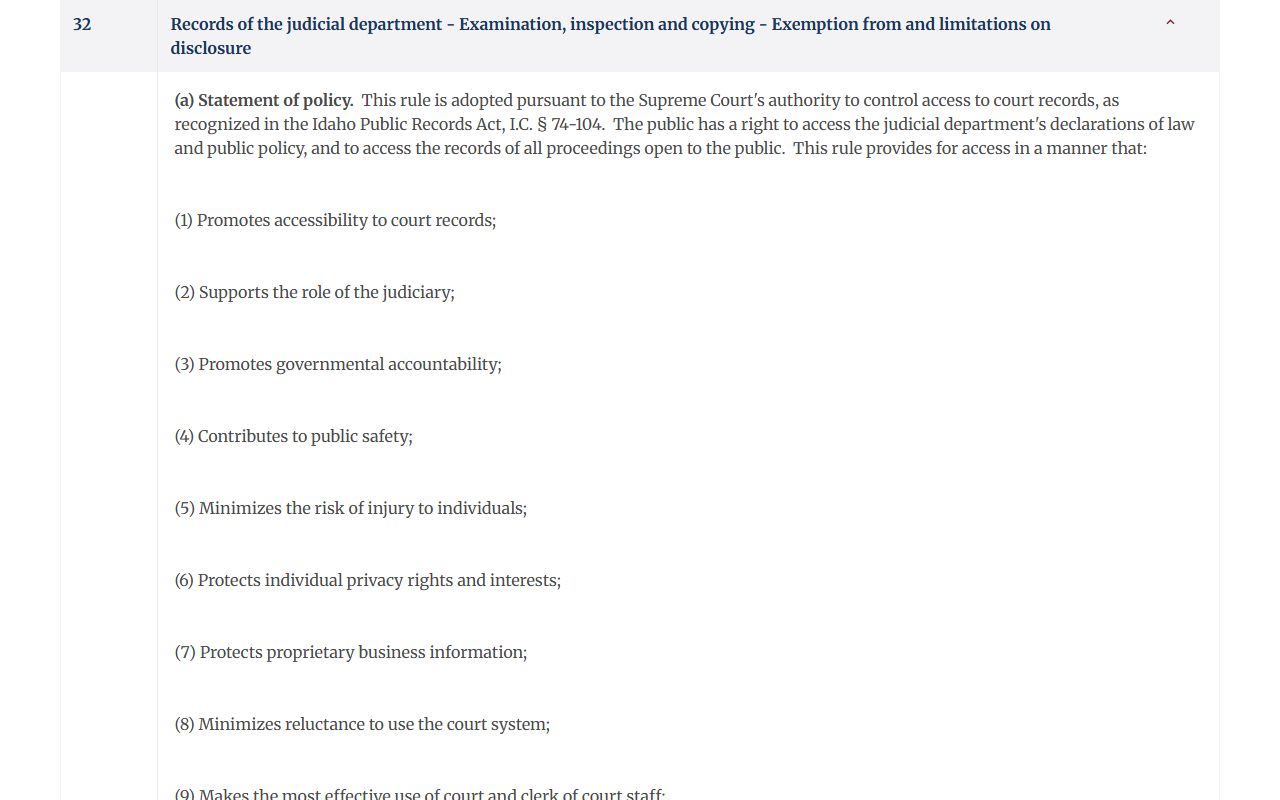
Use Rule 32 when deciding whether a missing online result means no case exists or whether the record may be confidential, sealed, or available only through a court request.
| Sealed | Expunged or Set Aside | |
|---|---|---|
| Public Visibility | Hidden or restricted from ordinary public access by rule or court order. | Relief depends on the statute, order, and record type; not every record is destroyed. |
| Law-Enforcement Access | May remain available to authorized agencies in limited circumstances. | May still have exceptions for authorized criminal-justice use. |
| Common Route | Court order, confidentiality rule, juvenile law, victim protection, or sealed-case procedure. | Qualifying dismissal, withheld judgment, or other relief under statutes such as Idaho Code 19-2604. |
| Public Search Effect | The case or document may not appear in normal public portal results. | The public-facing result may change only after the court and record custodian process the order. |
Prosecutor Contact for Court Records After an Arrest
The Twin Falls County Prosecuting Attorney is Grant Loebs. The office address is 425 Shoshone Street North, Twin Falls, ID 83301. The phone number is 208-736-4020, the fax number is 208-736-4182, and listed office hours are Monday-Friday, 8:00 a.m. to 5:00 p.m. The prosecutor reviews law-enforcement referrals and files the formal charges that become part of the court record.
The Twin Falls County Prosecuting Attorney page is the local source for prosecutor office routing after a jail arrest.
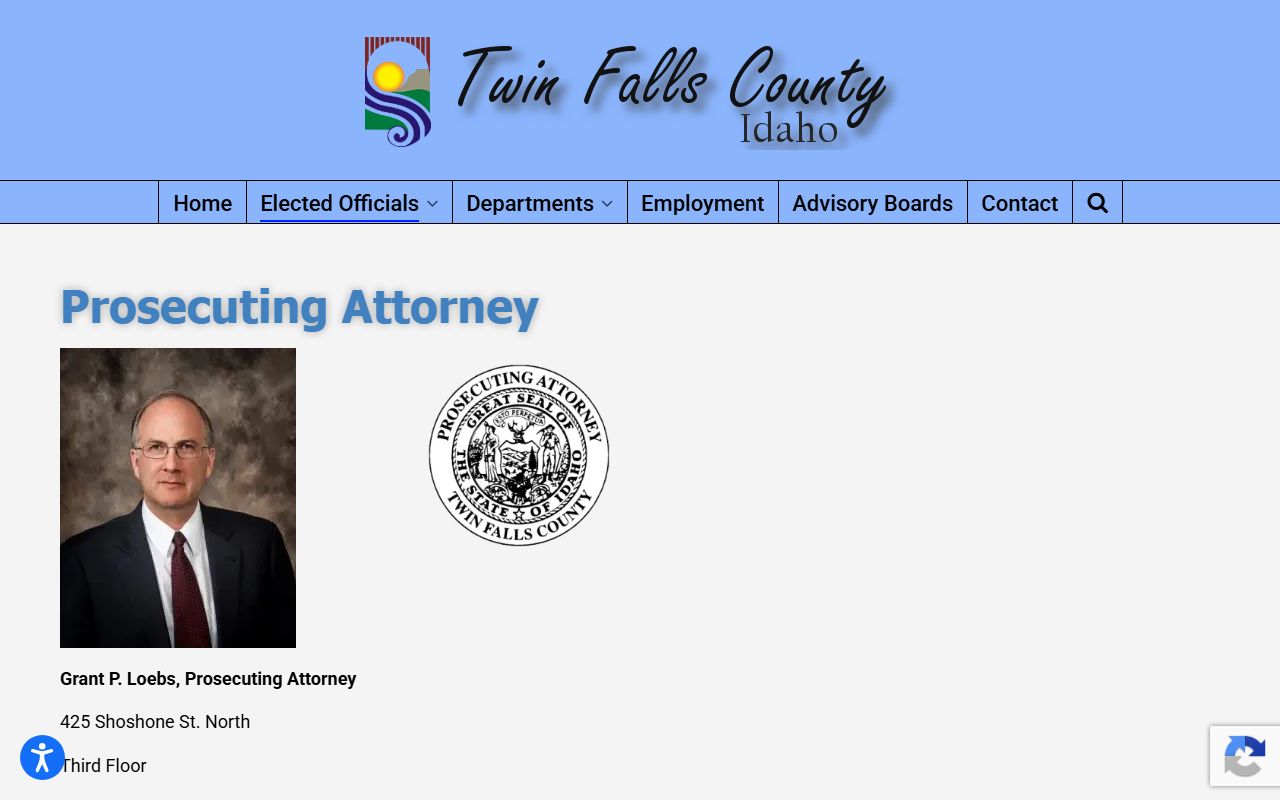
For discovery, charging decisions, victim services, and case-event questions, separate the prosecutor's role from the jail's custody role and the clerk's court-record access role.
Background Check Considerations
A casual court-record search is not the same as an FCRA-compliant background check, an Idaho State Police criminal-history response, or legal advice. Idaho Code 19-4701 matters because statewide criminal-history records and court case records are separate systems. A person's jail arrest may produce a custody record, a court case, a warrant entry, and a criminal-history entry, but those systems do not update at the same speed or show the same fields.
Important: This site is not a consumer reporting agency and court or jail information from it must not be used for FCRA-covered decisions.
Restricted Court Records After an Arrest in Twin Falls County
Public access is broad but not unlimited. Idaho Code 74-102 gives the public a right to examine and copy public records unless an exemption applies, while Idaho Code 74-103 controls public-record request response timing. Idaho Code 74-124 governs many law-enforcement-record exemptions and still requires release of certain basic arrest information, but it does not make every investigative detail public. Rule 32 adds the court-record side of the same caution.
If a Twin Falls County court record is missing from the public portal, possible explanations include a sealed case, juvenile confidentiality, a restricted victim or witness record, protected personal information, an older file that needs clerk assistance, a case under a different name spelling, or no formal charge having been filed. Verify with the originating office before relying on any single search result.